

The correct spelling is living room—two separate words. I know it’s tempting to merge them, especially since we write “bedroom” as one word, but that’s where English gets tricky. Dictionaries, retailers, and style guides all agree: it’s two words. The “-ing” ending resists bonding with nouns the way base words do.
If you’ve been typing “livingroom,” you’re not alone—autocorrect and typing habits trip us all up. Stick with “living room” in professional contexts, and there’s plenty more to explore about why this compound works the way it does.
Is It One Word or Two? The Short Answer
Why does it matter whether we write “living room” or “livingroom”? The answer is straightforward: living room is correct as two separate words, not one. I’ve checked everything from style guides to dictionaries, and they’re unanimous here. You won’t find “livingroom” listed as standard in contemporary English. The pattern makes sense when you think about it. English resists closing up compounds when the first word ends in “-ing,” like our gerund “living.” It just doesn’t flow naturally as one word. So when you’re writing about that space where your family gathers, stick with living room—two words, every time.
Why “Livingroom” Appears in Some Contexts
Despite the clear standard, you’ll still spot “livingroom” floating around—and there’s actually a reason it keeps popping up.
Despite the clear standard, “livingroom” keeps appearing—and there’s actually a legitimate reason why.
Several factors explain why this nonstandard form persists:
- Typing shortcuts: People naturally run words together when texting or writing quickly, and “livingroom” just flows faster than two separate words
- Autocorrect mishaps: Your phone or computer might randomly combine them, especially if you’ve typed it that way before
- Compound word confusion: English has tons of closed compounds like “bedroom” and “kitchen,” so your brain assumes “living room” should match that pattern
- Casual internet culture: Online spaces are less formal, making errors more common and spread
I’ve caught myself doing it too. The living room example shows how our brains seek consistency. We see “bedroom” and think “livingroom” should follow suit. It doesn’t, though. Standard usage keeps it as two words, even when habits suggest otherwise.
What Dictionaries Say About Living Room Spelling
How do the folks who actually write dictionaries handle this whole “living room” situation? They’re pretty consistent, honestly. The Oxford English Dictionary shows tons of entries with “ing room” or “ing-room”—think dining room, waiting room, sitting room. But here’s the thing: you won’t find “ingroom” as a single word anywhere in there. I’ve checked, and dictionaries treat “living room” as two separate words, no exceptions. That’s not random either. It reflects how English actually works in this semantic space. We simply don’t smoosh these words together into one. The OED’s lexical preferences tell us something real about our language’s structure. When dictionaries speak with one voice like this, it’s worth paying attention and following their lead.
How Regions and Generations Spell “Living Room”
I’ve noticed that where you live and when you were born really shapes how you spell “living room”—some folks in the UK still prefer “sitting room,” while Americans stick with “living room” as two words, and older generations might’ve picked up different terms altogether. The way we form compound words has actually shifted over time, so what seemed natural to your grandparents might look odd to you today. Understanding these regional and generational patterns helps explain why you’ll see variations in spelling and naming across different English-speaking countries.
Regional Spelling Preferences Across Cultures
When you cross from one English-speaking country to another, you’d think the spelling of “living room” might shift like the accent does—but in fact: it really doesn’t.
I’ve checked dictionaries across America, Britain, Australia, and beyond. Here’s what I found:
- American English: “living room” (two words, always)
- British English: “living room” (same two-word standard)
- Australian English: “living room” (consistent across the continent)
- Commonwealth varieties: “living room” (no regional closed-compound versions)
The living room stays spelled the same way everywhere. You won’t find “livingroom” in Oxford, Merriam-Webster, or any major dictionary. Regional differences pop up in what people *call* the space—drawing room, sitting room, lounge—but never in how it’s written.
Generational Differences In Usage Patterns
Does the way your grandparents talk about their home differ from how you’d describe yours?
You’ve probably noticed it. Your grandma might mention her “parlour” or “drawing room,” while you’d simply say “living room”—two words, no fuss. That shift happened during the mid-20th century when homes became less formal and more about everyday comfort.
Here’s the thing: spelling stays consistent across ages. We all write “living room” as two words, whether we’re twenty or eighty. The real generational difference isn’t about spelling; it’s vocabulary. Younger speakers stick with “living room” exclusively. Older generations sometimes reference those older terms in formal contexts, but they’ll still spell our modern phrase the same way you do. Regional traditions matter far more than age does.
Evolution Of Compound Word Formation
The history of how we spell “living room” reveals something fascinating about English itself: our language resists squishing this phrase into one word, and there’s actually a good reason why. I’ve noticed that compound words with “-ing” endings stubbornly resist becoming closed compounds. Here’s what I’ve discovered:
- The OED’s first “living room” quote dates to 1787, establishing the two-word standard
- Dictionary searches show countless multi-word phrases starting with “living,” but zero entries for “livingroom”
- That “-ing” ending makes our brains want spacing or hyphens, not closure
- Regional dialects consistently maintain this separation across generations
This pattern isn’t random. The “-ing” formation naturally resists compression into single words. Whether you’re in America, Britain, or elsewhere, you’re following centuries of linguistic preference. We’re all part of something larger—a shared standard that actually works.
The Compound Word Rule That Applies Here
Why does “living room” stay as two words instead of squishing together into “livingroom”? There’s actually a rule at work here. Words ending in -ing—like “living”—rarely form closed compounds with other words in English. Instead, they prefer staying separate or getting hyphenated. I discovered this when searching dictionaries and found countless entries for “living room” as a two-word term, but zero results for “livingroom” as one word. It’s not random. English morphology follows patterns, and -ing words are rebels against concatenation. They’d rather maintain their independence. So “living room” stays spaced, while related forms like “living-in” get hyphenated. This pattern keeps our language readable and prevents awkward word clusters that’d slow us down.
Where “Livingroom” Shows Up (Branding and Casual Writing)
Now that we’ve established why “living room” resists becoming a single word, here is where it gets interesting—because not everyone follows the rules.
You’ll spot “livingroom” in certain contexts where standard conventions take a backseat:
- Casual online writing: Blogs and social media sometimes merge it into one word for speed or stylistic choice
- Niche branding: Some furniture companies or apps use “livingroom” to create a distinctive identity
- Informal signage: Local businesses occasionally adopt unconventional spelling for memorable branding
- Personal websites: Individuals building their own sites sometimes standardize it their way
Here’s the thing: these instances don’t change what’s correct. They’re exceptions proving the rule. When you’re writing professionally or formally, “living room” remains your safest bet. It’s what readers expect, what they understand instantly, and what keeps you sounding polished.
Why “Bedroom” Proves the Rule (and “Living Room” Doesn’t)
I’ll show you why “bedroom” is the perfect proof that English compound words follow actual rules—and why “living room” breaks them in the most predictable way possible. The difference comes down to that pesky “-ing” ending: “bed” + “room” fuses naturally into one word, but “living” + “room” resists closing up because the gerund form fights against compression in a way that simple nouns don’t. Once you spot this pattern, you’ll notice it everywhere, and honestly, it’s kind of satisfying to realize English isn’t just randomly messy—it’s systematically messy.
The -Ing Ending Exception
What’s the deal with “bedroom”? It’s basically English’s favorite rule-breaker, and I’ll explain why it doesn’t actually help your “living room” situation.
Here’s what makes bedroom special:
- Bedroom formed as one word despite having an -ing element, making it a genuine exception
- Living room stubbornly stays two words because -ing compounds resist closing at the start
- OED evidence shows “ing room” entries but never “ingroom” as a single word
- The pattern reveals a linguistic preference against -ing as the initial element in closed compounds
See, bedroom’s success came from historical usage patterns that don’t apply to living spaces. When I investigated the OED, I found zero evidence supporting “livingroom” as a standard form. The -ing ending just doesn’t cooperate with compound formation the way you’d hope. That’s why your living room stays separated, my friend.
Bedroom’s Closed Compound Status
But the gist is: “living room” never made that leap. You won’t find “livingroom” in any reputable dictionary because “-ing” compounds resist fusion. The bedroom proves the rule by existing as the exception we’re comparing against. Understanding why bedroom succeeded where livingroom never stood a chance reveals how English spelling conventions actually develop. It’s not random—it’s pattern-based, and that pattern protects “living room” in its two-word form.
Morphological Rules And Patterns
English has unwritten rules about which compounds stick together and which ones stay apart, and the -ing morpheme is one of the biggest rule-makers in the game. You see, morphology—that’s the study of word structure—reveals why “bedroom” became one word while “living room” stayed two.
Here’s what’s happening:
- The -ing ending creates a natural barrier between words, making closed compounds unlikely
- Present participles like “living” resist bonding with nouns the way base nouns do
- English speakers instinctively keep -ing compounds open or hyphenated
- Dictionary patterns confirm this: you’ll find “ing-room” or “-ing room,” never “ingroom”
“Bedroom” works because “bed” is a straightforward noun. But “living” is different—it’s a verb form acting as an adjective, and that grammatical identity keeps our living room stubbornly separate.
Historical Evolution From “Parlour” to “Living Room”
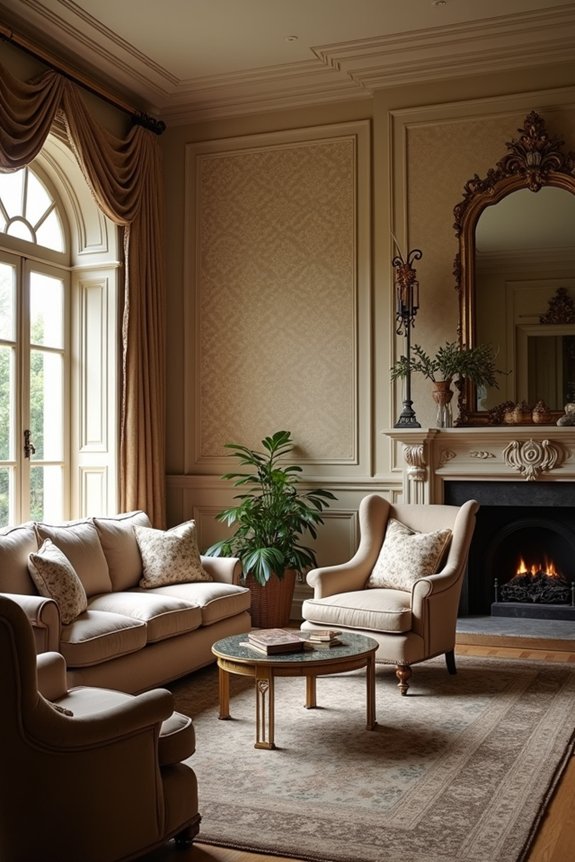
How’d we get from stuffy parlours to the comfy family rooms we understand today? The shift happened gradually through the late 1800s and early 1900s. Parlours were formal spaces reserved for entertaining guests—basically rooms you’d avoid hanging out in daily. Then Edward Bok and *Ladies’ Home Journal* started promoting affordable, practical living spaces. They championed the idea that families deserved rooms designed for everyday use, not just special occasions. The living room emerged as this new concept: one multipurpose space combining what used to be separate parlors, libraries, and drawing rooms. Homes shifted from rigid formality to genuine comfort. You’d find sofas arranged for conversation rather than stiff chairs lining walls. This evolution reflected a fundamental shift—we started designing homes around how we actually lived.
How Retailers Spell It
When I started noticing how major furniture retailers actually label their products, I found that “living room” as two separate words dominates everything from store signage to online catalogs—and it’s not even close. You’ll see this standard spelling in furniture industry conventions across the board, where “living room” appears in product names, category headers, and specification sheets with consistent regularity. The hyphenated and closed-form versions rarely show up in official retail materials, which tells us that the two-word format has become the industry’s default standard.
Retail Signage Standards
Because you’ve probably wandered through a furniture store and noticed how they label their sections, you’ll find that most retailers stick with the two-word form “living room” on their signs, product listings, and category headers. Here’s what I’ve discovered about how stores standardize this term:
- Consistency matters: Two-word spacing appears across catalogs and online platforms
- Dictionary influence: Multi-word styling guides retailers’ design choices
- Hyphenation is rare: “Living-room” occasionally shows up in brochures but stays uncommon
- Functional clarity: Signage emphasizes the living room as your daily family space
This standardization helps you navigate stores more easily and understand product categories quickly. When retailers separate “living room” from terms like “family room,” they’re signaling different purposes. You’re joining countless shoppers who recognize this familiar spacing pattern throughout retail spaces.
Furniture Industry Conventions
Now that we’ve seen how signage standardizes the term, let’s look at what’s actually happening behind the scenes in the furniture world itself. I’ve noticed that major retailers—think IKEA, Ashley Furniture, and Wayfair—consistently use “living room” as two words in their product categories and catalogs. It’s their industry standard. When I’m browsing online, I see “Living Room Furniture” headers everywhere, which reinforces this convention among professionals. You’ll occasionally spot “livingroom” in SEO tags or headlines, but that’s the exception, not the rule. The furniture industry’s alignment with dictionaries tells us something: they’ve settled on “living room” because it’s clear, professional, and universally understood. Following their lead keeps your own writing credible and consistent with what customers already expect.
Living Room Spelling Mistakes
How many times have you typed “livingroom” in an email only to catch yourself mid-send?
You’re not alone. I’ve made this mistake countless times, and I’ve noticed I’m in good company. Here’s what trips us up:
- The -ing ending makes us want to squish it together
- Autocorrect sometimes doesn’t catch our slip-ups
- We see similar compound words and assume this one follows suit
- Muscle memory from typing it wrong once sticks around
The truth is simple: “living room” stays as two separate words. The OED confirms it. No hyphens, no closed compound forms. That -ing ending actively resists merging into one word—it’s just how English works in this semantic space.
Once you lock in the correct spelling, you’ll catch yourself automatically. We’ve all been there, learning as we go.
Pick the Right Term for Your Context
Think about how you actually use the space. Your living room is where your family hangs out daily, watches movies, and lounges around. It’s unpretentious and lived-in. But if you’ve got a fancier sitting area near your front entrance reserved for guests? That’s probably a formal living room or parlor instead.
Regional terms matter too. Some folks call theirs a “family room” or “great room,” especially in open-concept homes. The key? Match the term to your space’s actual purpose and character.
Key Takeaways on Living Room Terminology
Living Room Terminology
Whether you’re composing an email to your realtor or labeling a furniture catalog, you’ll want to get the terminology right. “Living room”—written as two separate words—is the standard you’ll see in dictionaries, style guides, and real estate listings.
Here’s what matters most:
- Two words wins: Dictionary evidence overwhelmingly supports “living room” as the correct form
- Avoid “livingroom”: Single-word versions don’t appear in standard references
- Hyphens are rare: You’ll encounter “living-in” constructions, but not for typical room descriptions
- Context stays consistent: Real estate, design, and publishing all use two-word formatting
Getting this right isn’t about perfectionism—it’s about joining conversations where everyone understands you clearly. When you use “living room,” you’re speaking the language that matters to the people around you.